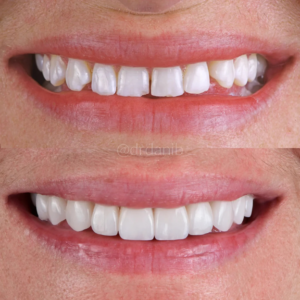
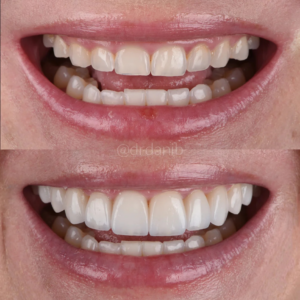
Your bite affects more than how your teeth come together. When certain teeth receive more pressure than others, the imbalance may contribute to tooth wear, chips, sensitivity, jaw tension, or discomfort. Dr. Dani B. discusses bite function as an important part of dental care, particularly when planning restorations such as porcelain veneers and implants. The practice also uses biometric dentistry to examine jaw movement, muscle function, and bite forces.
T-Scan adds another way to study these forces. This digital technology records how much relative force occurs across the teeth and when those contacts happen. For patients interested in T-Scan dentistry in Los Angeles, the technology can provide measurable information about dental occlusion and help a dentist better understand an uneven bite.
What Is T-Scan in Dentistry?
T-Scan is a digital system used for occlusal analysis. A thin electronic sensor is placed between the upper and lower teeth while the patient bites. As the teeth contact, the sensor records changes in relative force and timing. The information is then displayed through software for the dentist to review.
This makes T-Scan different from traditional bite-marking methods. Articulating paper can show where teeth touch, but T-Scan provides additional information about relative force and the sequence of tooth contacts. This can give the dentist a more detailed view of how the bite functions.
This type of digital information may be useful when a patient has concerns about tooth wear, an uneven bite, jaw discomfort, or the function of existing or planned restorations.
Dr. Dani B.’s practice already places significant attention on digital dentistry and bite evaluation. Its office lists digital X-rays and an iTero digital scanner, while the practice’s biometric dentistry content describes digital scans, jaw-motion recording, and bite analysis.
Also Read: Can Cosmetic Dentistry Fix an Uneven or Asymmetrical Smile in Los Angeles?
How T-Scan Detects Bite Imbalances
T-Scan records the distribution of bite force as the patient closes. If some areas receive more relative force than others, those differences can appear in the digital analysis. The system can also record when contacts occur, allowing the dentist to examine the sequence of the bite.
This is particularly relevant to T-Scan for bite imbalance. A patient may feel that the teeth do not meet evenly, but the dentist may need additional information to understand where the imbalance occurs and how the teeth interact during closure.
Unlike articulating paper, which primarily shows where teeth make contact, T-Scan adds information about relative force and the timing of those contacts.
Dr. Dani B.’s biometric approach follows a similar data-driven philosophy. The practice explains that biometric dentistry examines jaw movement, muscle function, and bite forces. Its jaw-mapping process combines digital tooth scans with jaw-motion information to create a model of the mouth in action.
Can T-Scan Identify an Uneven Bite?
T-Scan can reveal differences in relative force and contact timing that may help a dentist evaluate whether the bite is functioning unevenly. The findings are interpreted alongside the clinical examination and other relevant records.
How Does T-Scan Analyze Bite Force?
T-Scan uses an electronic sensor to record changes in relative force as the patient bites. The software displays how that force is distributed across the dental arch over time.
This is one of the reasons T-Scan dental bite analysis can provide information beyond a traditional visual bite check. Instead of only seeing where the teeth touch, the dentist can examine how force is distributed and how that distribution changes during closure.
The timing of contacts is also important. Two teeth may touch, but one may contact before another. T-Scan can record this sequence and show how the bite develops as the patient closes.
That information can contribute to T-Scan occlusal analysis, especially when a dentist is evaluating restorations or investigating signs that the bite may not be functioning evenly.
What Can T-Scan Reveal About Your Bite?
T-Scan can provide information about several aspects of dental occlusion, including:
- Relative bite force
- Force distribution across the teeth
- Timing of tooth contacts
- The sequence in which contacts occur
- Areas receiving greater relative pressure
- Changes in force during closure
- Movement of the center of force
These measurements can give the dentist additional information when evaluating concerns about bite function.
The dentist can interpret these measurements alongside the patient’s symptoms, clinical examination, and physical condition of the teeth.
Dr. Dani B.’s practice takes a similar approach to understanding bite function. Its biometric dentistry process includes digital 3D scans, jaw-motion recording, and bite analysis. The practice explains that these records can help show where stress is occurring and how the teeth interact as the jaw moves.
Also Read: How Customized Jaw Mapping Lets Biometric Dentistry Prevent Long-Term Wear on Your Teeth
Why Bite Imbalances Matter
An uneven bite can place greater pressure on certain teeth. Over time, this may contribute to wear, chips, sensitivity, or problems with restorations. Dr. Dani B.’s discussion of biometric dentistry explains that the way teeth meet and move against one another can play a role in dental wear. The practice also discusses jaw pain, headaches, chipped or flattened teeth, and repeated dental repairs as concerns that may warrant closer evaluation.
Bite evaluation is particularly relevant when planning cosmetic or restorative dentistry. Dr. Dani B.’s porcelain veneer process includes bite evaluation, impressions, and bite registration to assess how veneers will fit with opposing teeth. The practice also states that bite analysis is part of its assessment for minimal-prep veneers.
For implants, the practice also discusses bite forces as part of biometric planning. Its implant article explains that an implant must function within the patient’s bite and that bite analysis can be used to evaluate the forces involved.
Benefits of Digital Bite Analysis
One benefit of digital bite analysis is the additional information it can provide about how the teeth function together.
Measurable force information
T-Scan records relative bite force rather than relying solely on the appearance of contact marks. This can help the dentist identify areas receiving greater pressure.
Timing information
The system records when contacts occur, giving the dentist another way to examine the sequence of the bite.
A visual way to understand the bite
Digital results can be displayed visually, which may make it easier for patients to understand what the dentist is evaluating.
Support for treatment planning
Bite information can be considered when planning or adjusting restorations. This is relevant to veneers, crowns, implants, and other procedures where the relationship between opposing teeth matters.
Dr. Dani B.’s practice similarly incorporates digital information into treatment planning. Its office uses the iTero Intraoral Element Scanner to create 3D scans for Invisalign aligners and restorative appliances such as crowns.
Also Read: Before You Get Porcelain Veneers in Los Angeles, Here’s Why Your Bite Needs to Be Evaluated First
T-Scan Dentistry in Los Angeles
Patients with uneven tooth contact, unexplained dental wear, jaw discomfort, or concerns about existing restorations may benefit from a closer evaluation of how their teeth come together. Dr. Dani B.’s approach combines clinical examination with digital and biometric information to better understand bite function before restorative or cosmetic treatment is planned.
When appropriate, T-Scan can provide additional information about relative force, contact timing, and contact patterns. These findings can be considered alongside other clinical and digital records to develop a more complete picture of how the bite functions.
Frequently Asked Questions
What is T-Scan in dentistry?
T-Scan is a digital occlusal analysis system that records relative bite force and the timing of tooth contacts. It gives dentists additional information about how the teeth come together.
How does T-Scan detect bite imbalances?
T-Scan records relative force distribution and contact timing while the patient bites. The dentist can review the data to identify areas where force may be concentrated or where contacts occur at different points during closure.
Can T-Scan identify an uneven bite?
T-Scan can reveal differences in relative force and contact timing that may help a dentist evaluate whether the bite is functioning unevenly. The findings are interpreted alongside the clinical examination and other relevant records.
How does T-Scan analyze bite force?
An electronic sensor records changes in relative force as the patient bites. The software then displays how that force is distributed across the teeth over time.
What can T-Scan reveal about your bite?
T-Scan can provide information about bite force, contact timing, force distribution, contact patterns, and the movement of the center of force.
Conclusion
T-Scan can be one part of a broader bite evaluation when patients have uneven tooth contact, unexplained dental wear, discomfort, or concerns about how restorations are functioning. Its findings are most useful when interpreted alongside the clinical examination and other information about the teeth and jaw.
Dr. Dani B.’s practice places strong attention on bite function through biometric dentistry, jaw mapping, digital scanning, and bite analysis. Its approach considers how teeth, jaw movement, muscles, and bite forces work together when planning cosmetic and restorative care.
If you are experiencing signs of an uneven bite or are considering veneers, implants, or other restorative treatment, a professional bite evaluation can help determine what is happening and whether further analysis is appropriate. To learn more about Dr. Dani B.’s services or request a consultation, click here.