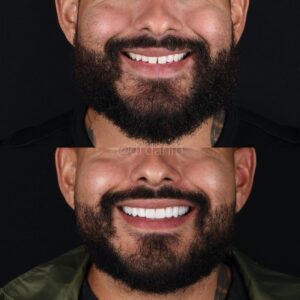
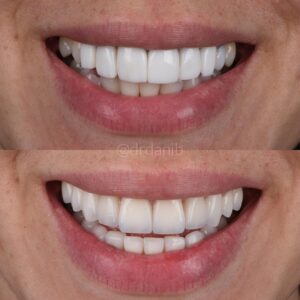
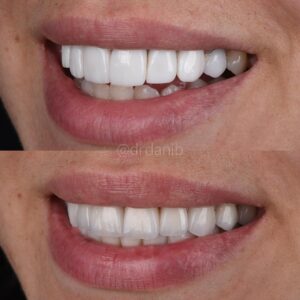
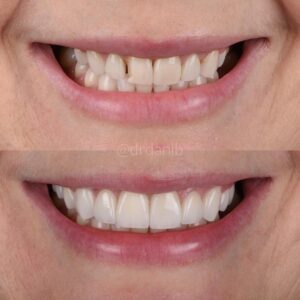
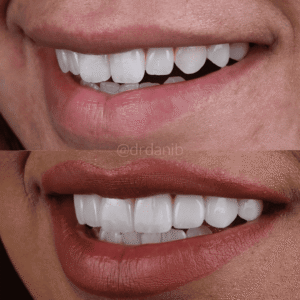
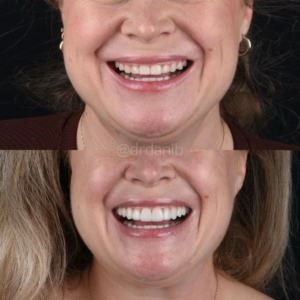
If you’ve been considering porcelain veneers but aren’t comfortable with the idea of removing healthy enamel, no-prep veneers may be worth exploring. These ultra-thin ceramic restorations can improve the appearance of small teeth, minor gaps, uneven edges, and certain types of discoloration, often without the tooth reduction associated with traditional veneers.
The appeal is straightforward: you can make meaningful changes to your smile while preserving more of your natural tooth structure. However, achieving a beautiful result without preparation requires careful planning. The porcelain must have enough room to look natural, fit comfortably, and work with your bite.
At Dr. Dani B., we approach cosmetic dentistry with an emphasis on natural-looking results, facial harmony, and preserving healthy teeth whenever possible. During your consultation, we evaluate whether no-prep veneers can achieve your goals or whether another conservative treatment would produce a better result.
What Are No-Prep Veneers?
No-prep veneers are custom-made porcelain shells bonded to the front surfaces of teeth without intentionally removing enamel to create space.
They’re designed to improve the visible shape, proportions, or color of teeth while maintaining their underlying structure. Some no-prep veneers measure approximately 0.2–0.3 millimeters thick, allowing them to make subtle changes without dramatically increasing tooth size.
This approach can work particularly well for teeth that are naturally small, slightly set back, or separated by minor gaps.
The challenge is creating enough room for the porcelain. If your teeth already project forward or are crowded, adding material can make them appear bulky. That’s why we evaluate your tooth position, gumline, and bite before recommending treatment.
How Do No-Prep Veneers Compare With Traditional Veneers?
Traditional porcelain veneers often require selective enamel reduction to create room for the restoration. The amount varies, but preparation may involve approximately 0.5 millimeters of enamel in certain areas.
No-prep veneers take a different approach. Rather than removing tooth structure to accommodate the porcelain, we design the restoration around the existing tooth whenever possible.
Both treatments can produce natural-looking results. The appropriate choice depends on your starting tooth shape, alignment, color, and desired changes.
For example, a small tooth may benefit from the added volume of a no-prep veneer. A tooth that already protrudes may require some preparation to avoid creating an overly prominent appearance.
Why Preserving Enamel Matters
Healthy enamel provides an excellent surface for bonding porcelain restorations.
Preserving enamel can support predictable bonding and reduce the amount of natural tooth structure altered during treatment. It also fits our broader approach to conservative cosmetic dentistry.
No-prep veneers still require careful surface conditioning before bonding. They should also be considered long-term restorations, since removing bonded porcelain later can affect the underlying enamel.
Also Read: Demystifying the Myths Surrounding No-Prep Veneers: What You Need to Know
How Much Do No-Prep Veneers Cost in Los Angeles in 2026?
Cost is often one of the first questions patients ask when considering no-prep veneers.
In Los Angeles, porcelain veneer pricing varies based on the dentist’s experience, the materials used, the number of teeth treated, and the complexity of the smile design.
At Dr. Dani B., our published general porcelain veneer pricing is approximately 1,900–3,000 per tooth. This is a reference range for porcelain veneers, not a fixed quote specifically for no-prep treatment.
Your actual no-prep veneer cost is determined after we examine your teeth and develop a personalized treatment plan.
What Affects the Cost?
Several factors influence the final investment:
Number of veneers: Treating one or two teeth differs from designing a complete smile makeover.
Ceramic material: The porcelain must provide the appropriate strength, translucency, and appearance.
Smile design: Matching tooth proportions, facial features, and surrounding teeth requires individualized planning.
Ceramic customization: Our in-house master ceramist helps refine shade, texture, and contours for a natural appearance.
Additional treatment: Whitening, orthodontics, or other dental care may be recommended before veneers.
During your consultation, we’ll discuss your goals, determine which teeth would benefit from treatment, and provide a written estimate.
Are No-Prep Veneers More Affordable Than Traditional Veneers?
Not necessarily.
Although no-prep veneers may involve less enamel reduction, their fabrication still requires detailed planning and precise ceramic work. In some cases, creating an extremely thin restoration that blends naturally with the surrounding teeth can be particularly demanding.
The best comparison is not simply the price per tooth. It’s whether the treatment will achieve your desired result while maintaining appropriate tooth contours, function, and long-term dental health.
No-Prep Veneers vs. Traditional Veneers vs. Dental Bonding
Each treatment offers a different way to improve your smile.
| Treatment | Tooth Preparation | Best Suited For |
|---|---|---|
| No-prep porcelain veneers | No intentional enamel reduction in suitable cases | Small teeth, minor gaps, subtle shape changes |
| Minimal-prep veneers | Selective enamel reduction | Cases needing limited space for porcelain |
| Traditional porcelain veneers | More preparation may be necessary | Greater changes in tooth shape, contour, or color |
| Composite bonding | Usually minimal or no enamel removal | Small chips, minor gaps, localized cosmetic improvements |
Porcelain generally offers excellent stain resistance and natural translucency. Composite bonding can be a more conservative and easily repairable option for certain minor concerns.
We evaluate these options based on what your teeth actually need rather than recommending veneers automatically.
Learn more about our porcelain veneer treatments in Los Angeles.
Are You a Good Candidate for No-Prep Veneers?
No-prep veneers work best when adding a small amount of porcelain can improve your smile without creating excessive thickness.
When No-Prep Veneers Work Well
You may be a good candidate if you have:
Naturally small teeth: Porcelain can improve tooth size and proportions.
Peg-shaped lateral incisors: Narrow or undersized teeth beside the front teeth may benefit from added fullness.
Minor gaps: Carefully designed veneers can close selected spaces between teeth.
Small chips or worn edges: Porcelain may restore a smoother, more balanced appearance.
Slightly recessed teeth: Teeth positioned farther back may have room for added porcelain.
Mild discoloration: Certain color differences can be improved when thin ceramic provides sufficient coverage.
Healthy enamel and gums are also important considerations. We assess the condition of your teeth and how the proposed restorations will function when you bite and chew.
When Another Treatment May Be Better
No-prep veneers aren’t always the most conservative choice.
If your teeth are already prominent or crowded, adding porcelain may make them look too thick. Significant rotation or bite misalignment may also require orthodontic treatment before cosmetic restorations.
Deep discoloration can be difficult to conceal with ultra-thin porcelain. In these cases, a different veneer design or another cosmetic treatment may provide a more natural result.
We also address untreated decay, gum disease, or significant grinding concerns before proceeding.
Our goal is to recommend the treatment that improves your smile while respecting the health and function of your natural teeth.
Also Read: Top 9 Reasons to Choose Minimal Prep Veneers vs Traditional Veneers
What to Expect During the No-Prep Veneer Process
No-prep veneers require careful attention to tooth proportions, ceramic thickness, and bonding. We plan each step around your existing smile and the changes you want to make.
Step 1: Consultation and Digital Smile Planning
Your consultation begins with a discussion about your goals.
We examine your teeth, gums, bite, and existing restorations. Photographs and digital scans help us evaluate tooth position, proportions, and how your smile looks when you speak and laugh.
We also determine whether the proposed changes can be achieved without enamel reduction.
If no-prep veneers are appropriate, we’ll review the design, explain the treatment process, and discuss the expected cost.
Step 2: Custom Porcelain Fabrication
Once the design is approved, your veneers are created to match the planned shape, shade, and proportions.
Our in-house master ceramist helps customize the ceramic’s translucency, surface texture, and fine details.
This craftsmanship is especially important with thin veneers because the underlying tooth color can influence the final appearance.
We want the restorations to blend naturally with your smile rather than look like porcelain has simply been added to the teeth.
Step 3: Try-In and Bonding
Before permanently bonding the veneers, we evaluate their fit, appearance, and relationship to your bite.
A try-in paste may help us assess how the bonding cement will influence the final shade.
Once the appearance and fit are approved, the tooth and porcelain surfaces are prepared for bonding. The veneers are secured with dental resin cement, and we carefully check the margins and bite.
Many no-prep cases require little or no anesthesia because substantial enamel reduction is avoided.
Treatment often takes approximately two to three appointments, although the exact schedule depends on your case.
How Long Do No-Prep Veneers Last?
No-prep porcelain veneers can last many years with appropriate care.
Their longevity depends on several factors, including the ceramic material, bonding quality, tooth position, bite forces, and daily habits.
Traditional porcelain veneers also have strong long-term outcomes. Neither treatment has a guaranteed lifespan, and there isn’t enough consistent evidence to conclude that no-prep veneers universally last fewer years than traditional veneers.
To protect your restorations, we recommend maintaining regular dental visits, practicing good oral hygiene, and avoiding habits such as chewing ice or using your teeth to open packages.
If you grind your teeth, a custom night guard may help reduce excessive forces on your veneers.
Dental Insurance and Financing Options
Because veneers are generally considered cosmetic treatment, dental insurance often does not cover their cost.
Some plans may provide benefits for eligible restorative procedures, depending on the circumstances and policy terms.
We can review your proposed treatment and help you understand what to confirm with your insurance provider.
Our practice also offers access to financing options, including CareCredit, Cherry, Alphaeon Credit, and Proceed Finance.
Approval, interest rates, and promotional terms vary by provider. We’ll explain available options and review your written treatment estimate before you decide how to proceed.
Learn more about dental financing options.
Also Read: When Are Veneers Better Than Orthodontics
Why Choose Dr. Dani B. for No-Prep Veneers in Los Angeles?
A natural-looking smile isn’t simply about making teeth whiter or more uniform. Tooth proportions, facial features, lip movement, and the way your teeth fit together all influence the final result.
Dr. Dani B. completed his undergraduate studies at UCLA and earned his dental degree from the NYU College of Dentistry. His cosmetic and restorative approach emphasizes thoughtful treatment planning and preserving healthy tooth structure whenever possible.
At our West Los Angeles practice, digital smile planning and collaboration with our in-house master ceramist allow us to customize the details that make each smile distinctive.
We consider whether no-prep veneers can improve your appearance without compromising tooth contours or bite function. When another treatment would better serve your goals, we’ll explain why.
Patients from Beverly Hills, Century City, and throughout Southern California visit our practice for individualized cosmetic dental care.
Frequently Asked Questions About No-Prep Veneers
How Much Do No-Prep Veneers Cost Per Tooth in Los Angeles?
Our published general porcelain veneer pricing is approximately 1,900–3,000 per tooth. No-prep veneer costs are determined individually based on your teeth, ceramic design, and treatment needs. We’ll provide a personalized estimate during your consultation.
Are No-Prep Veneers Truly Reversible?
Not reliably. Although no-prep veneers avoid intentional enamel reduction in suitable cases, bonding and eventual removal can affect the tooth surface. They should be considered long-term restorations.
Will No-Prep Veneers Make My Teeth Look Bulky?
Proper patient selection and careful design help avoid this problem. We assess tooth position, available space, gumline contours, and bite before recommending no-prep veneers. If adding porcelain would create excessive thickness, we’ll discuss other options.
How Long Do No-Prep Porcelain Veneers Last?
They can last many years, depending on the materials, bonding, bite forces, and maintenance. Regular dental care and avoiding excessive pressure on the restorations can help protect your investment.
Does Getting No-Prep Veneers Hurt?
Many no-prep cases require little or no anesthesia because significant enamel reduction isn’t necessary. Some patients experience temporary gum irritation or sensitivity. We’ll explain what to expect based on your individual treatment plan.
How Do I Schedule a No-Prep Veneer Consultation With Dr. Dani B.?
Contact our Los Angeles office to arrange a consultation. We’ll examine your teeth, discuss your smile goals, evaluate whether no-prep veneers are appropriate, and review your treatment options and estimated costs.
Schedule Your No-Prep Veneer Consultation in Los Angeles
No-prep veneers offer an appealing option for patients who want to improve their smiles while preserving healthy tooth structure. The key is determining whether your teeth have the right shape, position, and available space for an additive porcelain design.
At Dr. Dani B., we take the time to evaluate these details and create a treatment plan that complements your natural smile.
Explore No-Prep Veneers at Dr. Dani B. and schedule a consultation to learn whether this conservative cosmetic treatment is right for you.
Disclaimer: This article provides general dental education and pricing information. Actual treatment costs, candidacy, and outcomes vary based on individual clinical findings. A dental examination is necessary to determine the most appropriate treatment plan.