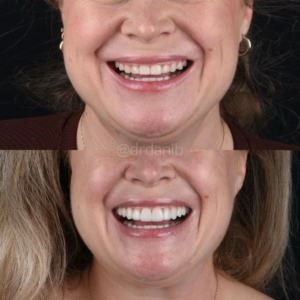
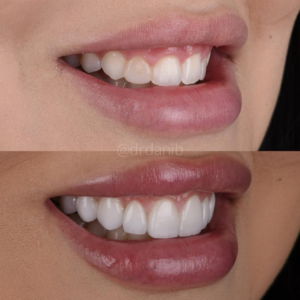
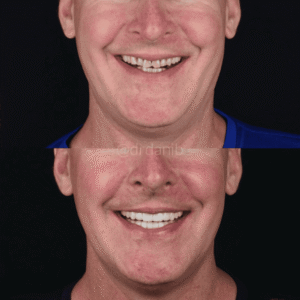
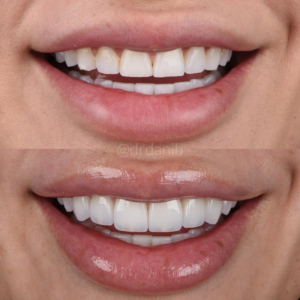
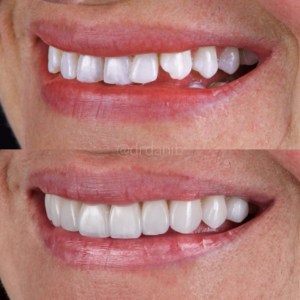
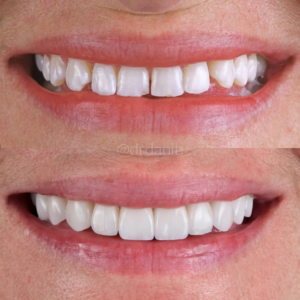
Patients considering veneers do not always want a dramatic smile transformation. Sometimes the goal is much more specific: refine the shape of a few teeth, improve proportions, close small spaces, or create a more polished smile without losing the features that already look like you.
For the right patient, no prep veneers can offer that kind of conservative approach. These thin cosmetic restorations are designed to enhance the appearance of teeth with little or, in some cases, no removal of natural enamel. Whether that is possible depends on the existing shape, position, and proportions of the teeth, as well as the changes you want to make.
At Dr. Dani B’s Beverly Hills cosmetic dentistry practice, the goal is not simply to avoid tooth preparation. It is to determine how much, if anything, needs to change to create a smile that looks balanced, natural, and appropriate for your face.
That distinction matters. The most conservative veneer is not necessarily the one with the least preparation. It is the one that preserves healthy tooth structure while still allowing the final restoration to have the right shape, contour, function, and appearance.
What Are No Prep Veneers?
No-prep veneers are thin cosmetic restorations bonded to the visible surfaces of teeth. In appropriately selected cases, they can be placed with little or no removal of natural enamel.
The amount of preparation required depends on several factors, including:
- Existing tooth shape and size
- Tooth position and alignment
- Available enamel
- Spacing between teeth
- Bite and functional contacts
- Desired changes in tooth shape or color
- The thickness and contour needed for the planned veneer
This is why “no prep” should not be treated as a requirement that every cosmetic case has to meet.
Imagine a tooth that already projects slightly forward. Adding another layer of restorative material without creating space for it could make the tooth look thicker or more prominent. In that situation, limited enamel preparation may actually produce a more natural-looking result.
No-prep, minimal-prep, and traditional veneers therefore exist along a spectrum rather than representing three completely separate philosophies. The appropriate approach is the one that creates enough space for the restoration while preserving as much healthy tooth structure as clinically appropriate.
Also Read: Demystifying the Myths Surrounding No-Prep Veneers: What You Need to Know
Can No Prep Veneers Look Natural?
Yes, but the natural appearance does not come from the absence of tooth preparation alone.
A veneer can be extremely thin and still look unnatural if its proportions, contour, shade, or surface characteristics do not fit the rest of the smile.
Natural-looking veneers depend on details such as:
- Tooth length and width
- Contour
- Translucency
- Surface texture
- Shade
- Light reflection
- Smile line
- Gum display
- Relationship to neighboring teeth
- Overall facial proportions
Natural teeth are not perfectly identical. They have subtle variations in shape, texture, translucency, and the way they reflect light. Trying to make every tooth exactly the same size, shape, and shade can sometimes make cosmetic dentistry more noticeable rather than less.
For patients who already have naturally attractive tooth shapes, the goal may be to preserve that character rather than replace it with a standardized veneer design.
That might mean refining an edge, improving symmetry, adjusting proportion, closing a small space, or making a controlled change in color while keeping the features that make the smile look individual.
Who May Be a Good Candidate for No Prep Veneers?
No-prep veneers tend to make the most sense when there is enough room to add a thin restoration without making the teeth look bulky.
A dentist may evaluate:
- Natural tooth dimensions
- Existing tooth shape
- Tooth position
- Enamel condition
- Spacing
- Bite
- Smile line
- Gum display
- Desired color changes
- Desired changes in tooth length or width
For example, a patient with smaller teeth or small spaces between otherwise well-positioned teeth may have room for carefully planned additional material. A patient who likes the basic shape of their smile but wants subtle refinement may also be a good candidate.
The important question is not simply, “Can a veneer be bonded without preparing this tooth?”
It is, “Will adding material to this tooth create the shape and proportion we actually want?”
Those are not always the same thing.
When No Prep Veneers May Not Be the Best Choice
Preserving enamel is valuable, but avoiding preparation at all costs can work against the aesthetic goal.
If a tooth is already prominent, large, rotated, crowded, or positioned too far forward, adding veneer material may make it appear even more prominent. Significant changes in tooth color or position may also require a different restorative approach.
In these cases, limited enamel preparation may allow the dentist to control the final contour without unnecessarily increasing the size of the tooth.
Some patients may also be better served by another cosmetic treatment altogether. The purpose of the consultation is to determine what will create the desired result with an appropriate amount of intervention, not to force every smile into a no-prep treatment plan.
Also Read: Before You Get Porcelain Veneers in Los Angeles, Here’s Why Your Bite Needs to Be Evaluated First
No Prep vs. Minimal Prep vs. Traditional Veneers
The main difference is how much tooth structure needs to be modified to create room for the restoration.
No prep veneers may require little or no enamel reduction in carefully selected cases.
Minimal prep veneers involve limited enamel preparation when additional space or contour control is needed.
Traditional veneers may require more deliberate preparation to accommodate the restoration and create the intended tooth shape.
None of these approaches is automatically more natural-looking than the others.
A no-prep veneer placed on the wrong tooth can look too thick. A conservatively prepared veneer designed specifically for the patient’s anatomy can look extremely natural.
For that reason, treatment planning should begin with the desired result and the existing tooth anatomy, not with a predetermined promise that the teeth will never be prepared.
No Prep Veneers in Beverly Hills: Preserving the Character of Your Smile
For patients considering no prep veneers in Beverly Hills, smile design begins with what is already there.
Dr. Dani B evaluates factors such as facial proportions, tooth dimensions, smile line, gum display, tooth color, alignment, and bite before determining which cosmetic approach is appropriate. Photography, diagnostic models, digital planning, or other planning tools may also be used when appropriate.
This is particularly important for someone who already likes the general character of their smile.
A smile makeover does not have to mean dramatically changing every tooth. Conservative cosmetic dentistry may focus on subtle improvements to shape, proportion, spacing, or color while preserving features that already complement the face.
The question becomes less about creating a completely different smile and more about deciding which details are worth changing and which should be left alone.
What Makes Veneers Look Like Natural Teeth?
Natural-looking veneers have to work as part of the entire smile.
Proportion
The width and length of each veneer should make sense in relation to the neighboring teeth. Even a beautifully made restoration can look artificial if it is too wide, too long, or too dominant within the smile.
Contour
A veneer needs enough contour to create the desired shape without appearing bulky. This is especially important in no-prep cases because restorative material is being added to the existing tooth surface.
Translucency and Light
Natural enamel interacts with light rather than appearing completely opaque. Veneer material, shade, and thickness all contribute to how naturally the restoration blends with surrounding teeth.
Individual Tooth Character
A natural smile does not require every tooth to look identical. Subtle variations in shape and surface characteristics can help the finished result look like teeth rather than a uniform set of restorations.
Facial Harmony
The teeth are only one part of the result. The smile should also relate appropriately to the lips, gums, smile line, and overall facial proportions.
Also Read: How Many Dental Veneers in Los Angeles Do I Actually Need for a Natural Smile?
What to Expect With No Prep Veneers
Treatment begins with determining whether no-prep veneers are actually appropriate for your teeth.
1. Consultation and Examination
Dr. Dani B evaluates your teeth, gums, bite, existing restorations, and overall smile. This is also the time to discuss what you like about your current smile and what you would like to change.
That distinction can be especially useful for patients seeking a subtle result. Knowing what should be preserved is just as important as knowing what should be corrected.
2. Smile Design
Tooth proportions, shape, shade, smile characteristics, and facial relationships are considered when developing the treatment plan.
The goal is not to select a generic veneer shape. It is to determine what dimensions and contours fit your existing anatomy.
3. Diagnostic Planning
Photography, models, digital planning, or a trial design may be used when appropriate.
This stage is particularly important in a potential no-prep case because the dentist needs to determine whether material can be added without creating excessive thickness.
If the proposed design would make a tooth look too prominent, minimal preparation or another treatment approach may provide a better result.
4. Veneer Fabrication
The restorations are fabricated according to the treatment plan, including the planned shape, proportions, shade, and surface characteristics.
5. Try-In and Evaluation
When appropriate, the proposed restorations can be evaluated before final bonding. This gives the dentist an opportunity to assess how the veneers relate to the surrounding teeth and overall smile.
6. Bonding
Once the restorations have been evaluated, the veneers are bonded to the teeth according to the treatment plan.
7. Follow-Up
The result is evaluated after treatment, and adjustments can be made when clinically appropriate.
The overall timeline varies depending on the number of veneers, laboratory process, complexity of the case, and whether any additional dental treatment is required.
Are No Prep Veneers Reversible?
The term “no prep” can make veneers sound temporary, but they should still be approached as a long-term restorative treatment.
Even when little or no enamel is removed, veneers are restorations that are bonded to the teeth. Patients should not choose them with the assumption that they can simply be removed later and everything will necessarily return to exactly how it was before treatment.
The amount of tooth preparation, bonding process, condition of the underlying teeth, and future restorative needs all matter.
If preserving as much natural enamel as possible is important to you, that should be part of the treatment-planning conversation before you decide to proceed.
How Long Do No Prep Veneers Last?
Veneers are designed to be durable, but they are not indestructible and will not necessarily last for a lifetime.
Longevity varies depending on the veneer material, bite, oral hygiene, habits, treatment design, and individual circumstances.
Regular dental care remains important after treatment. Patients should also avoid using their teeth to open packages, bite hard objects, or perform other tasks that place unnecessary force on the restorations.
Over time, veneers may require maintenance, repair, or replacement.
Preserving Your Natural Smile Starts With the Right Treatment Plan
No-prep veneers can be an appealing option for patients who want cosmetic refinement without unnecessarily removing healthy tooth structure. But the best result does not come from pursuing “no prep” as a label.
It comes from understanding the existing teeth first.
For some patients, adding a very thin restoration can improve proportion, spacing, shape, or color while preserving the character of the natural smile. For others, limited preparation may be necessary to prevent excessive thickness or create a more balanced contour. And in some cases, another cosmetic treatment may make more sense.
At Dr. Dani B’s Beverly Hills cosmetic dentistry practice, treatment planning begins with your anatomy, your smile, and the changes you actually want to make.
Frequently Asked Questions
What Are No Prep Veneers?
No-prep veneers are thin cosmetic restorations bonded to the visible surfaces of teeth with little or, in some cases, no removal of natural enamel. Whether this is possible depends on the patient’s tooth shape, position, bite, enamel, and treatment goals.
Can No Prep Veneers Look Natural?
Yes. Natural-looking results depend on appropriate case selection and careful attention to proportion, contour, translucency, texture, shade, and overall smile design. Avoiding tooth preparation alone does not guarantee a natural result.
Can No Prep Veneers Make My Teeth Look Bulky?
They can if there is not enough room to add restorative material while maintaining appropriate tooth proportions. Teeth that are already prominent, large, crowded, or positioned forward may require limited preparation or a different treatment approach to avoid excessive bulk.
Are No Prep Veneers Reversible?
No-prep veneers should not automatically be considered reversible simply because little or no enamel is removed. They are bonded restorations intended as a long-term cosmetic treatment, and future removal or replacement needs depend on the individual case.
How Do No Prep Veneers Differ From Traditional Veneers?
The primary difference is the amount of tooth preparation. No-prep veneers require little or no enamel reduction in appropriately selected cases, while traditional veneers may require more preparation to create space for the restoration and achieve the planned contour.
How Long Do No Prep Veneers Last?
Longevity varies based on the material, treatment design, bite, oral hygiene, habits, and individual circumstances. Veneers may eventually require maintenance, repair, or replacement.
Can No Prep Veneers Fix Crooked Teeth?
They may improve the appearance of minor alignment or spacing concerns in selected cases, but they do not physically move teeth the way orthodontic treatment does. More significant crowding, rotation, or tooth-position concerns may require another approach.
Are No Prep Veneers Good for Naturally Shaped Teeth?
They can be particularly useful when a patient already likes the general shape and position of their teeth and wants controlled cosmetic changes. The dentist still needs to determine whether adding veneer material will preserve appropriate proportions rather than making the teeth look too large.
What Happens if I Am Not a Candidate for No Prep Veneers?
Not being a candidate for a completely no-prep approach does not necessarily mean extensive tooth preparation is required. Depending on your anatomy and goals, minimal-prep veneers or another cosmetic treatment may provide a more appropriate result.
How Do I Know Which Type of Veneer Is Right for My Smile?
The decision should be based on your existing tooth anatomy, enamel, bite, tooth position, desired changes, and overall smile design. A cosmetic consultation with Dr. Dani B can determine whether no-prep, minimal-prep, traditional veneers, or another treatment approach best fits those factors.